
 Sullivan County, Missouri
... a member of The MOGenWeb Project
 During site update: Page NOT in new design | Page still on old site
You've read the short "Early History" on the Home page. So you know how our county was born from the rolling hills of north-central Missouri in 1845, named in honor of Revolutionary statesman James Sullivan. But what happened after those first six townships drew their borders and established their voting precincts? Once the early settlers put down roots, Sullivan County truly came alive through connection, commerce, and community.
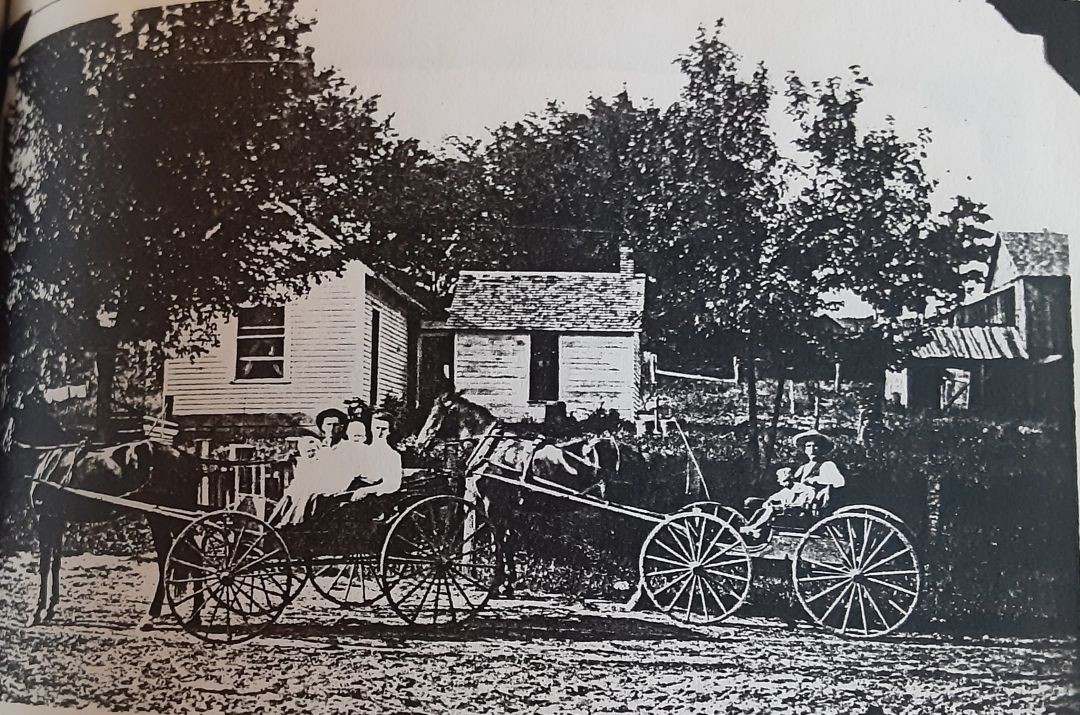 Following its official organization in 1845, Sullivan County quickly transitioned from a quiet frontier into a bustling agricultural community. The earliest pioneers—largely arriving from Kentucky, Virginia, Tennessee, and Ohio, et al, were drawn to the fertile valleys shaped by Medicine, Locust, and Yellow creeks. They built homes, established small family farms, and laid out the early foundations of our towns.
Picture taken 1908 Buggies & the Custers, posted 7 Oct 2025 by Gayle Chipchase.
1st buggy: Reuben and Lillian Custer, Marjorie and Baby Harry Custer
2nd buggy: Jacob H Custer, driving Bluebelle, grandson Glen Custer
Harry Custer was born in this house in Sticklerville, MO.
Click image to see it enlarged in a new tab.
By the late 19th century, everything changed with the arrival of the "Iron Horse."
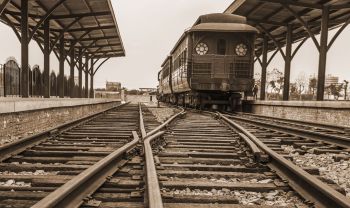 Between 1870 and 1886, a massive railroad expansion connected Sullivan County to the rest of the nation. The lines crossed directly in Milan, which became a vital division point and a booming shipping center.
Because of this rail network, local farmers could easily ship their grain, livestock, and timber to major midwestern markets.
Image courtesy of Magnific.com.
By 1900, the county's population peaked at over 20,000 residents. The land was highly productive, dotted with over 3,000 small, family-operated farms specializing in poultry, dairy, and cattle. This farming economy was supported by localized industries; bituminous coal fields near Mil were mined to power local homes, and limestone quarries provided materials for sturdy building foundations. Main Streets in towns like Green Castle, Green City, and Pollock flourished with banks, dry goods stores, and community newspaper offices.
 The decades leading up to 1950 brought a shift toward modernization. As agricultural technology advanced, tractors replaced horsepower, and the size of local farms began to grow even as the overall number of farms decreased. Through the hardships of the Great Depression in the 1930s and the economic shifts of the 1940s, the community leaned heavily on its small-town bonds.
By 1950, the frantic pace of the early railroad era had slowed down, leaving behind a proud, resilient farming community with deep roots that still define Sullivan County today.
Above content provided by Gemini AI after requesting specific periods of history in the county.
The goal: to give you, the researcher, an idea of what happened in the county during the years. ~ L.Peach
 Important: Please give Credit when it is Due.
Note: USGenWeb & MOGenWeb Logos are Copyright
Protected. The material on Sullivan County, Missouri webpages is available for the free use of
individuals in furtherance of researching their personal genealogy. Any commercial use of this
content where money is asked for, for any reason, is strictly prohibited.